
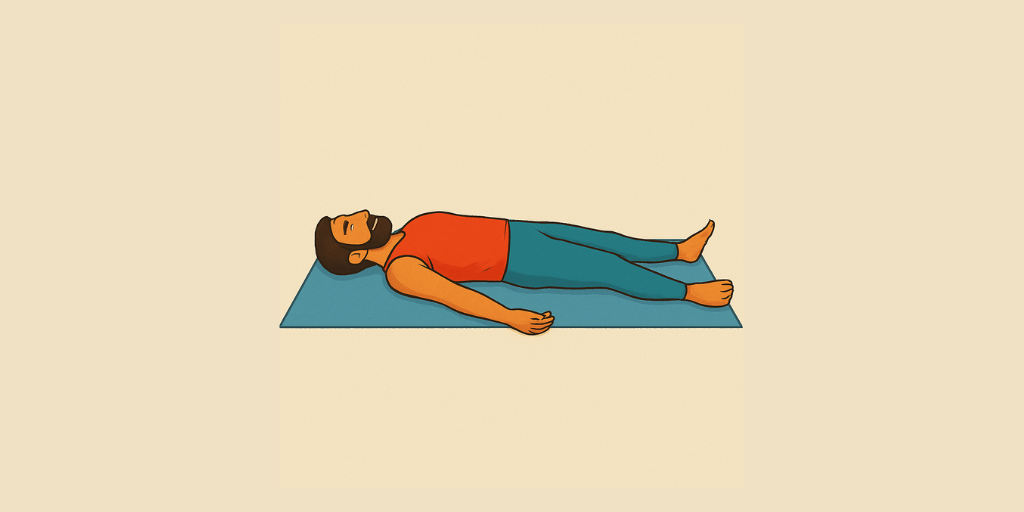
Sanskrit Name: शवासन
English Name: Corpse Pose
Description
It is also referred to as the corpse pose, this posture is practiced at the conclusion of a session. It enhances the connection between your mind and body, aiding in preparation for meditation.
Shavasana serves as a moment of introspection, prompting reflections like, “If today were my last day, would I feel fulfilled by what I’ve accomplished? Am I thankful for those who matter most to me?”
How to Do
Here are the steps to do Shavasana (Corpse Pose).
- Lie on Your Back: Start by lying flat on your back on a yoga mat or a comfortable surface. Spread your legs wide apart, about hip-width distance. Let your feet relax and point outward.
- Arms by Your Sides: Keep your arms extended by your sides with your palms facing upward. Let your fingers relax and curl slightly inward.
- Adjust Your Head and Neck: Align your head with your spine, making sure your neck is in a neutral position. Keep your head relaxed and your face soft.
- Relax Your Whole Body: Close your eyes and take a few deep breaths. With each inhale, feel your body expand. With each exhale, consciously release any tension in your body.
- Release Tension in Your Body: Starting from your toes, mentally scan your body. Release any tension in your feet, legs, hips, abdomen, chest, arms, shoulders, neck, and face. Let go of any physical discomfort and allow your body to sink into the floor.
- Focus on Your Breath: Breathe naturally, observing your breath as it enters and leaves your body. Let go of any thoughts and focus entirely on the rhythm of your breath. If thoughts arise, gently bring your attention back to your breath.
- Stay in the Pose: Remain in Shavasana for 5-15 minutes, or longer if you prefer. The key is to stay completely still, relaxed, and present. Let your body rest deeply and allow your mind to quiet down.
- To Exit the Pose: When you’re ready to exit, begin to bring your awareness back to your surroundings. Start by deepening your breath, gently moving your fingers and toes, and slowly stretching your body. When you feel ready, roll onto your right side and pause for a moment.
- Sit Up Slowly: Push yourself up to a seated position, keeping your eyes closed, and take a few moments to notice how you feel before moving on with your day.
It’s typically used at the end of a yoga session to relax and integrate the experience.
Benefits
- Shavasana, also known as Corpse Pose, offers several therapeutic benefits that contribute to overall well-being.
- It promotes deep relaxation, allowing the body to recover and rejuvenate.
- By reducing stress and anxiety levels, Shavasana helps in lowering blood pressure and improving heart health.
- Additionally, this pose aids in enhancing focus and mental clarity, as it encourages mindfulness and a sense of inner peace.
- Regular practice of Shavasana can also alleviate symptoms of insomnia and improve sleep quality, making it a valuable tool for those seeking to manage stress and promote emotional balance.
Medical Conditions(Relief)
- Relaxation: Helps relieve stress and tension in both the body and mind.
- Restoration: Restores energy, allowing the body to rejuvenate after physical activity.
- Mental Clarity: Calms the mind, reducing anxiety and promoting mental clarity.
- Improved Circulation: Encourages relaxation of the muscles and promotes circulation throughout the body.
- Reduces Fatigue: Helps counterbalance the effects of physical exertion, promoting a sense of peace and well-being.
Medical Conditions(Avoid)
- Severe Back Issues: Individuals with significant back pain or conditions like herniated discs may find it uncomfortable to lie flat on their backs.
- Pregnancy: Particularly in the later stages, lying flat on the back can compress the vena cava, affecting blood flow. Side-lying positions are often recommended instead.
- Recent Surgery: Those who have undergone recent abdominal or spinal surgery should avoid Shavasana until fully healed and cleared by a healthcare provider.
- Respiratory Issues: Conditions like severe asthma or COPD may make prolonged lying flat uncomfortable due to difficulty in breathing.
- Severe Anxiety or PTSD: Some individuals may feel vulnerable or anxious in a supine position, making it counterproductive for relaxation.
- Acid Reflux: Lying flat can exacerbate symptoms of acid reflux or GERD, so modifications may be necessary.
- Severe Fatigue or Illness: If someone is experiencing extreme fatigue or illness, they may find it difficult to remain still and may require a more supportive position.
References
- Patanjali, Yoga Sutras of Patanjali, Commentary by Swami Sivananda. Divine Life Society, 1990; p. 58.
- Swatmarama, Hatha Yoga Pradipika, Edited by Swami Muktibodhananda. Bihar School of Yoga, 1998; p. 72.
- Sushruta, Sushruta Samhita, Commentary by Acharya Y.T. (5th ed.). Varanasi: Chaukambha Orientalia, 1992; p. 445.
- Krishnamacharya, Yoga Makaranda, Translated by A.G. Mohan. Krishnamacharya Yoga Mandiram, 2012; p. 103.
- Iyengar B.K.S., Light on Yoga. HarperCollins Publishers, 1966; p. 102.
- Desikachar T.K.V., The Heart of Yoga: Developing a Personal Practice. Inner Traditions, 1995; p. 88.
- Jois K. Pattabhi, Yoga Mala. The Yoga Institute, 2002; p. 120.
- Swami Vivekananda, Raja Yoga. Advaita Ashrama, 1993; p. 61.
- Swami Sivananda, The Science of Pranayama. Divine Life Society, 1951; p. 99.
- Sivananda Yoga Vedanta Centres, Yoga and Health. Sivananda Publications, 2005; p. 45.

