
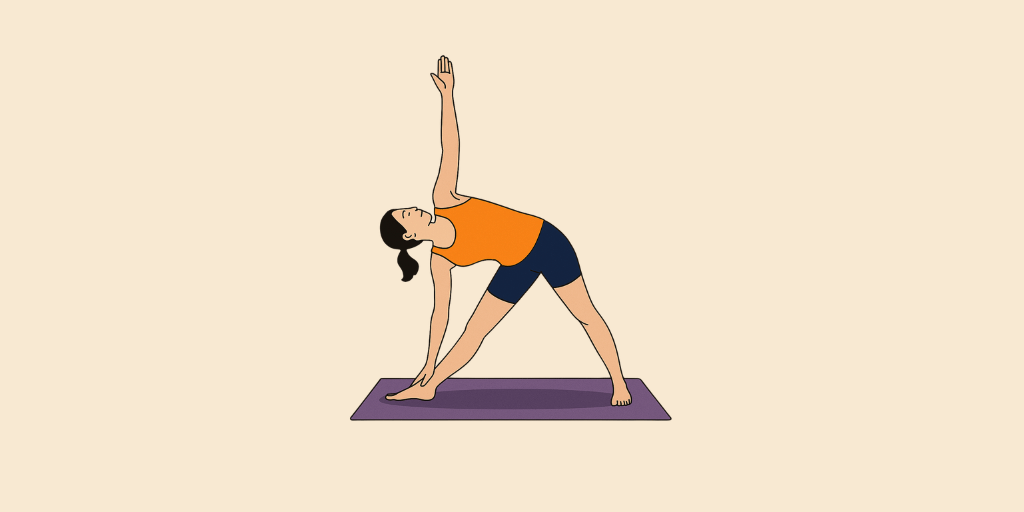
Sanskrit Name: त्रिकोणासन
English Name: Triangle Pose
Description
Trikonasana, commonly known as Triangle Pose, is an essential standing posture in yoga that emphasizes balance, flexibility, and strength. It is practiced in various styles such as Hatha, Vinyasa, and Iyengar yoga. This pose effectively stretches and opens the sides while also strengthening the legs and core.
In the rich tradition of yoga, each posture carries its own significance, and Trikonasana is no different. The name, rooted in ancient Sanskrit, reveals its meaning: ‘TRI’ signifies the mystical power of three, ‘KONA’ represents the elegant angles, and ‘ASANA’ denotes the practice of posture.
Trikonasana transcends mere physicality; it acts as a gateway to a deeper self-awareness. As you transition into this graceful form, you embark on a journey of self-discovery, revealing the profound connection between your breath, mind, and the surrounding world.
How to Do
Here are the steps to do Trikonasana (Triangle Pose).
- Stand with Feet Wide Apart: Start by standing with your feet about 3–4 feet apart, keeping your legs straight. Ensure your feet are parallel to each other.
- Turn Your Right Foot Out: Rotate your right foot 90 degrees outward so that the toes are pointing to the front. Your left foot remains slightly turned inward at around a 15-degree angle.
- Align Your Hips: Keep your hips squared and facing forward. Make sure your pelvis is neutral and not tilted.
- Stretch Your Arms Out: Extend both arms parallel to the floor, with your palms facing down. Your arms should be in line with your shoulders.
- Shift Your Hips and Reach: Inhale and as you exhale, begin to reach your right hand toward your right foot while pushing your left hip towards the left side to create a strong stretch through your torso.
- Lower Your Right Hand: Keep your core engaged as you bring your right hand down to the floor, your ankle, or a block (depending on flexibility). Your left arm should stay extended upward, in line with your shoulders, with your palm facing forward.
- Look Up: Turn your head and gaze up towards your left hand. Keep your neck relaxed.
- Hold the Pose: Stay in the pose for 15–30 seconds, breathing deeply and steadily. Keep your legs strong and engaged while keeping the stretch in your torso.
- Come Out of the Pose: To release, inhale and slowly lift your torso back up, coming into a standing position. Turn your feet forward and relax.
- Repeat on the Other Side: Repeat the steps on the other side by turning your left foot out and stretching your left hand towards your left foot.
If you find it difficult to reach the floor, use yoga blocks under your hand for support.
Benefits
- Incorporating Trikonasana into a regular yoga practice can lead to these significant physical and mental health benefits.
- Trikonasana, or Triangle Pose, offers several benefits for various medical conditions.
- It aids in alleviating stress and anxiety by promoting relaxation and mental clarity.
- This asana can enhance digestion and relieve gastrointestinal issues, as it stimulates the abdominal organs.
- Additionally, it helps in improving balance and coordination, which is beneficial for those recovering from injuries.
- Furthermore, Trikonasana strengthens the legs and stretches the spine, making it helpful for individuals with back pain or discomfort.
- Overall, this pose contributes to physical and mental well-being, supporting a healthier lifestyle.
Medical Conditions(Relief)
- Improves Flexibility: This asana stretches the legs, groins, hips, and spine, enhancing overall flexibility.
- Strengthens Muscles: It strengthens the legs, core, and back muscles, promoting better stability and balance.
- Enhances Digestion: The twisting motion aids in stimulating the digestive organs, improving digestion and alleviating issues like constipation.
- Reduces Stress: Practicing Trikonasana can help reduce anxiety and stress levels by promoting relaxation and mental clarity.
- Improves Circulation: The pose encourages better blood circulation throughout the body, which can enhance overall health.
- Relieves Back Pain: It can help alleviate tension in the back and relieve discomfort associated with back pain.
- Promotes Better Posture: Regular practice encourages proper alignment and posture, which can prevent future musculoskeletal issues.
Medical Conditions(Avoid)
- Severe Back Pain: Individuals with acute or chronic back issues may exacerbate their condition due to the twisting and lateral bending involved in the pose.
- Hip Injuries: Those with hip problems or injuries should refrain from this asana, as it requires significant hip mobility and flexibility.
- Neck Issues: People with neck injuries or chronic neck pain should avoid looking upward in the pose, which can strain the neck further.
- Pregnancy: Pregnant individuals should avoid this pose, especially in later trimesters, as it can put pressure on the abdomen and alter balance.
- Recent Surgery: Anyone recovering from surgery, particularly abdominal or hip surgery, should avoid Trikonasana to prevent strain and complications.
- High Blood Pressure: Those with uncontrolled hypertension should be cautious, as the pose can increase blood flow and pressure in the head.
References
- Patanjali, Yoga Sutras of Patanjali, Commentary by Swami Sivananda. Divine Life Society, 1990; p. 58.
- Swatmarama, Hatha Yoga Pradipika, Edited by Swami Muktibodhananda. Bihar School of Yoga, 1998; p. 72.
- Sushruta, Sushruta Samhita, Commentary by Acharya Y.T. (5th ed.). Varanasi: Chaukambha Orientalia, 1992; p. 445.
- Krishnamacharya, Yoga Makaranda, Translated by A.G. Mohan. Krishnamacharya Yoga Mandiram, 2012; p. 103.
- Iyengar B.K.S., Light on Yoga. HarperCollins Publishers, 1966; p. 102.
- Desikachar T.K.V., The Heart of Yoga: Developing a Personal Practice. Inner Traditions, 1995; p. 88.
- Jois K. Pattabhi, Yoga Mala. The Yoga Institute, 2002; p. 120.
- Swami Vivekananda, Raja Yoga. Advaita Ashrama, 1993; p. 61.
- Swami Sivananda, The Science of Pranayama. Divine Life Society, 1951; p. 99.
- Sivananda Yoga Vedanta Centres, Yoga and Health. Sivananda Publications, 2005; p. 45.

