
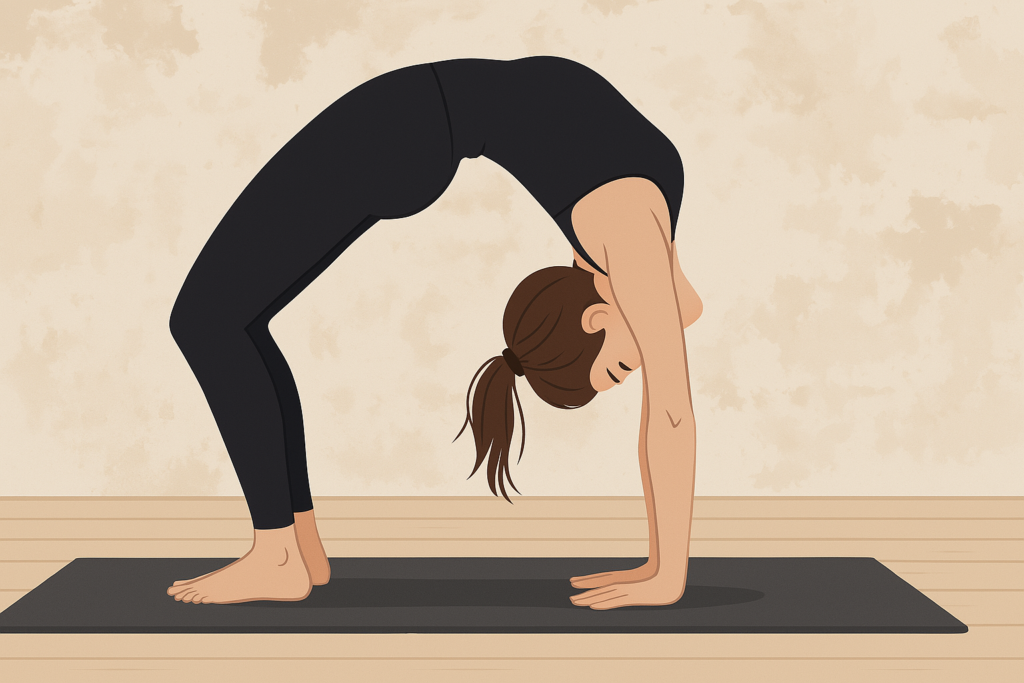
Sanskrit Name: चक्रासन
English Name: Wheel Pose
Description
Chakrasana, commonly referred to as Wheel Pose, is an advanced backbend in yoga that enhances chest opening, spinal flexibility, and strengthens both the arms and legs. In Sanskrit, “Chakra” (चक्र) translates to wheel or circle, while “Asana” (आसन) means pose or posture. Thus, Chakrasana means Wheel Pose, which reflects the circular shape your body forms during the practice. This name emphasizes the energetic and physical opening of the chest, hips, and heart that the pose encourages.
As a fundamental pose in Hatha Yoga, Chakrasana is recognized for boosting strength and flexibility. The wheel symbolizes energy, movement, and transformation. Practicing Chakrasana is believed to activate and balance the body’s energy, allowing prana (life force) to flow freely through the chakras, especially the heart and solar plexus chakras. Engaging in this pose can foster emotional release, renewal, and a sense of openness.
How to Do
Here are the steps to do Chakrasana (Wheel Pose).
- Lie on Your Back: Start by lying flat on your back with your knees bent and your feet flat on the floor, hip-width apart.
- Position Your Hands: Place your hands on the floor next to your ears, with your palms facing down and fingers pointing towards your shoulders.
- Feet Placement: Keep your feet firmly grounded on the floor, about hip-width apart, and parallel to each other.
- Engage Your Core: Engage your core muscles and ensure your legs, hips, and arms are active.
- Press into Your Hands and Feet: Press your palms and feet into the floor. Inhale and begin lifting your hips towards the ceiling.
- Lift Your Torso: Push through your hands and feet to lift your chest and hips up. As you press into your hands, start lifting your upper body off the floor, creating an arch in your spine.
- Straighten Your Arms and Legs: Once your chest and hips are lifted, try to straighten your arms and legs to form a curved shape (like a wheel) with your body. Keep your arms close to your ears and your legs active.
- Open Your Chest: Open your chest by lifting your sternum towards the ceiling. Keep your neck relaxed and gaze towards your hands or the floor (depending on comfort).
- Hold the Pose: Hold the pose for 10-30 seconds, breathing deeply and steadily. Focus on maintaining the arch in your spine and engaging your core.
- Release the Pose: To come out of the pose, gently bend your elbows and knees, and slowly lower your back to the floor. Rest in Savasana (Corpse Pose) or any comfortable position for a few moments.
If you’re new to Chakrasana, start with preparatory poses like Setu Bandhasana (Bridge Pose) and gradually work towards the full wheel.
Benefits
- It enhances the flexibility of the spine, improving posture and alleviating back pain.
- This asana strengthens the arms, legs, and core muscles, contributing to overall body strength.
- It stimulates the digestive organs, promoting better digestion and alleviating issues like constipation.
- The pose opens up the chest and lungs, enhancing respiratory function and increasing lung capacity.
- Practicing Chakrasana can elevate mood and reduce stress and anxiety by promoting the release of endorphins.
- It helps in balancing the energy flow in the body, aligning with the heart chakra, which can foster emotional stability.
Medical Conditions(Relief)
- Back Pain: This asana helps stretch and strengthen the spine, alleviating discomfort in the back.
- Respiratory Issues: By opening the chest, it enhances lung capacity and improves breathing.
- Digestive Problems: The pose stimulates abdominal organs, promoting better digestion and alleviating issues like constipation.
- Fatigue and Stress: It energizes the body and mind, helping to reduce feelings of fatigue and stress.
- Anxiety and Depression: Practicing Chakrasana can uplift mood and relieve symptoms of anxiety and depression by boosting overall energy and confidence.
Medical Conditions(Avoid)
- Back Injuries: Individuals with acute or chronic back injuries may exacerbate their condition by attempting this pose.
- Carpal Tunnel Syndrome: This pose places significant pressure on the wrists, which can worsen symptoms for those with carpal tunnel syndrome.
- Shoulder Injuries: Those with shoulder injuries or instability should avoid this asana to prevent further damage.
- Pregnancy: Pregnant women should avoid this pose, especially in the later trimesters, due to the strain on the abdomen and lower back.
- High Blood Pressure: This pose can increase blood pressure, so individuals with hypertension should refrain from practicing it.
- Glaucoma: The inversion aspect of Chakrasana can increase pressure in the eyes, making it unsuitable for those with glaucoma.
- Hernia: Individuals with a hernia should avoid this pose as it may aggravate their condition.
References
-
- Patanjali, Yoga Sutras of Patanjali, Commentary by Swami Sivananda. Divine Life Society, 1990; p. 58.
- Swatmarama, Hatha Yoga Pradipika, Edited by Swami Muktibodhananda. Bihar School of Yoga, 1998; p. 72.
- Sushruta, Sushruta Samhita, Commentary by Acharya Y.T. (5th ed.). Varanasi: Chaukambha Orientalia, 1992; p. 445.
- Krishnamacharya, Yoga Makaranda, Translated by A.G. Mohan. Krishnamacharya Yoga Mandiram, 2012; p. 103.
- Iyengar B.K.S., Light on Yoga. HarperCollins Publishers, 1966; p. 102.
- Desikachar T.K.V., The Heart of Yoga: Developing a Personal Practice. Inner Traditions, 1995; p. 88.
- Jois K. Pattabhi, Yoga Mala. The Yoga Institute, 2002; p. 120.
- Swami Vivekananda, Raja Yoga. Advaita Ashrama, 1993; p. 61.
- Swami Sivananda, The Science of Pranayama. Divine Life Society, 1951; p. 99.
- Sivananda Yoga Vedanta Centres, Yoga and Health. Sivananda Publications, 2005; p. 45.

