
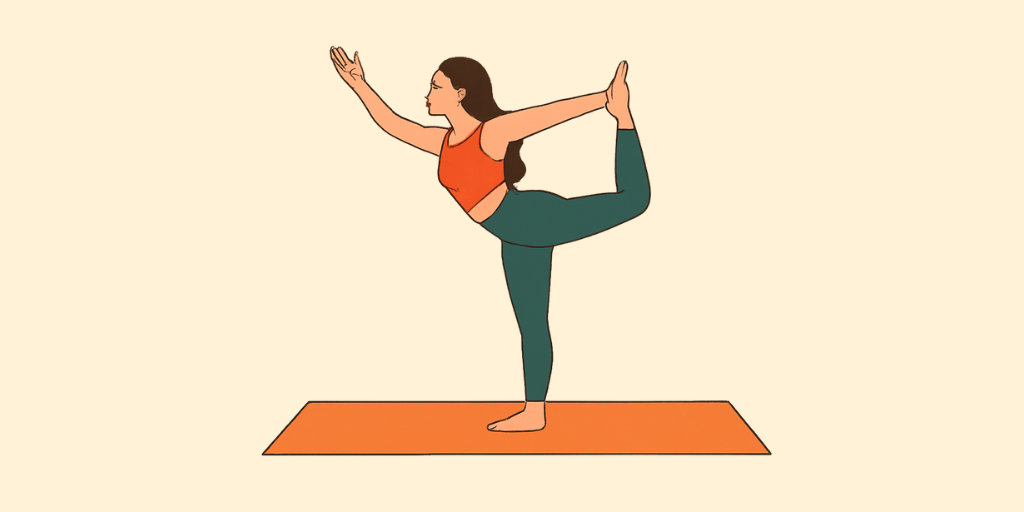
Sanskrit Name: नटराजासन
English Name: Lord of Dance Pose
Description
Nataraja, the deity of the cosmic dance, represents the perpetual cycles of creation, preservation, and destruction. Similarly, Natarajasana, named in his honor, teaches us to appreciate life’s contrasts. We encounter the dynamic dance of existence, filled with cycles, challenges, and rewards. Yet, beneath this activity, a profound stillness exists.
This pose invites us to witness the ebb and flow of life’s transitions while staying grounded in that inner stillness. It embodies the essence of finding peace amid life’s movements while continuing to engage with the world while preserving our inner tranquility.
How to Do
Here are the steps to do Natarajasana (Lord of the Dance Pose).
- Start in Tadasana (Mountain Pose): Begin by standing tall with your feet together, arms by your sides, and your body aligned. Engage your thighs, lift your kneecaps slightly, and ground your feet firmly into the floor.
- Shift Weight to One Leg: Gently shift your weight onto your left leg, standing tall and stable on it. Keep your left leg straight but not locked, and engage your core.
- Bend the Right Leg: Slowly bend your right knee and bring your right foot towards your glutes. Reach back with your right hand and grasp the inner arch of your right foot.
- Lift Your Right Foot: Once you’ve grasped your right foot, inhale and begin to lift your right leg upwards, keeping your chest open and spine straight. Keep your hips squared and avoid leaning to one side.
- Extend Your Left Arm Forward: Stretch your left arm forward, parallel to the floor, with your palm facing inward. Keep your fingers extended, creating a long, strong line from your fingertips to your toes.
- Open the Chest and Hips: As you lift your right leg higher, begin to gently open your chest and shoulders. Press your foot into your hand and reach through your left arm, creating a strong, fluid line through your body.
- Balance and Hold the Pose: Balance carefully, focusing on a point in front of you (drishti) to help with stability. Keep your body engaged, especially your core, to maintain balance. Hold the pose for 15–30 seconds.
- Release the Pose: To release, slowly lower your right leg and return to standing in Tadasana. Take a moment to reset your posture before repeating the pose on the other side.
Natarajasana is a beautiful and energizing pose that combines strength, flexibility, and grace.
Benefits
- Incorporating Natarajasana into your practice can lead to a holistic improvement in physical and mental well-being.
- Natarajasana, also known as the Dancer Pose, can be beneficial for various medical conditions.
- It helps in improving balance and coordination, which can be advantageous for individuals recovering from injuries or dealing with balance disorders.
- This pose also enhances flexibility in the spine and legs, aiding those with lower back pain or stiffness.
- Additionally, it promotes mental focus and concentration, which may assist individuals suffering from anxiety or stress-related conditions.
- Regular practice can contribute to overall strength and stability, making it suitable for those with muscle weakness or joint issues.
Medical Conditions(Relief)
- Improves Balance and Coordination: This pose enhances physical stability and coordination by requiring concentration and focus, which can translate to better balance in daily activities.
- Strengthens Muscles: Natarajasana engages various muscle groups, particularly in the legs, core, and back, helping to build strength and endurance.
- Enhances Flexibility: The pose stretches the hip flexors, thighs, and shoulders, promoting overall flexibility and reducing muscle tension.
- Boosts Mental Focus: Practicing this pose encourages mindfulness and concentration, which can help reduce stress and anxiety levels.
- Stimulates Circulation: The dynamic movement involved in transitioning into and holding the pose stimulates blood flow, promoting cardiovascular health.
- Promotes Emotional Balance: The graceful nature of Natarajasana can foster a sense of calm and emotional stability, aiding in the management of stress and enhancing mood.
- Encourages Mind-Body Connection: This asana fosters awareness of the body and breath, enhancing the connection between physical movement and mental clarity.
Medical Conditions(Avoid)
- Knee Injuries: Individuals with recent or chronic knee injuries should avoid this pose to prevent further strain or damage to the knee joint.
- Ankle Problems: Those suffering from ankle sprains or instability should refrain from practicing Natarajasana to avoid exacerbating their condition.
- Back Issues: People with severe back pain, herniated discs, or spinal injuries should avoid this pose, as it requires balance and can strain the back.
- Hip Injuries: Individuals with hip joint problems or injuries should not attempt this pose, as it places significant pressure on the hips.
- Pregnancy: Pregnant individuals should avoid this pose due to the balance required and potential risk of falling.
- Recent Surgery: Anyone who has undergone recent surgery, particularly in the legs, hips, or back, should avoid this pose until fully healed.
- Vertigo or Balance Disorders: Those with conditions that affect balance may find this pose challenging and should avoid it to prevent falls.
References
- Patanjali, Yoga Sutras of Patanjali, Commentary by Swami Sivananda. Divine Life Society, 1990; p. 58.
- Swatmarama, Hatha Yoga Pradipika, Edited by Swami Muktibodhananda. Bihar School of Yoga, 1998; p. 72.
- Sushruta, Sushruta Samhita, Commentary by Acharya Y.T. (5th ed.). Varanasi: Chaukambha Orientalia, 1992; p. 445.
- Krishnamacharya, Yoga Makaranda, Translated by A.G. Mohan. Krishnamacharya Yoga Mandiram, 2012; p. 103.
- Iyengar B.K.S., Light on Yoga. HarperCollins Publishers, 1966; p. 102.
- Desikachar T.K.V., The Heart of Yoga: Developing a Personal Practice. Inner Traditions, 1995; p. 88.
- Jois K. Pattabhi, Yoga Mala. The Yoga Institute, 2002; p. 120.
- Swami Vivekananda, Raja Yoga. Advaita Ashrama, 1993; p. 61.
- Swami Sivananda, The Science of Pranayama. Divine Life Society, 1951; p. 99.
- Sivananda Yoga Vedanta Centres, Yoga and Health. Sivananda Publications, 2005; p. 45.

