
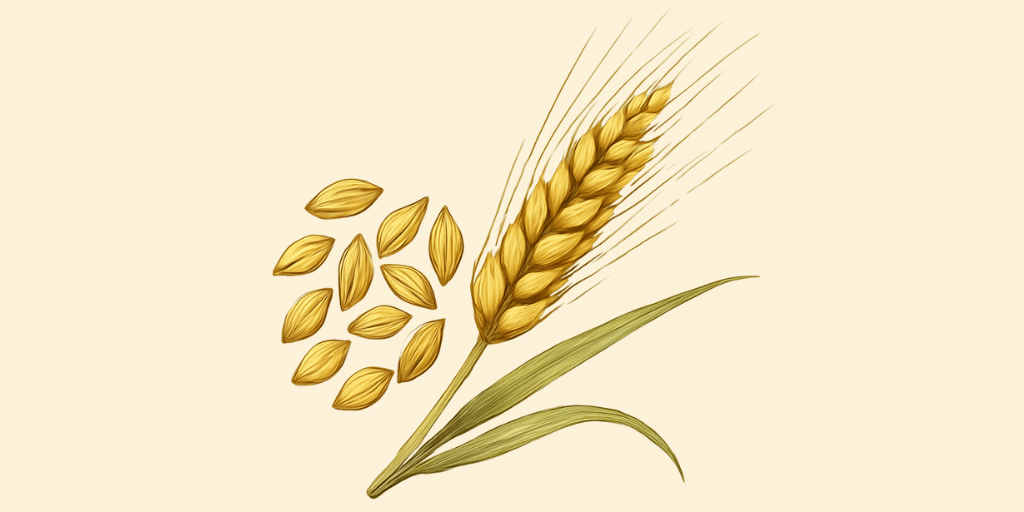
Sanskrit Name: Yava
Devanagari Name: जौं
Botanical Name: Hordeum vulgare
English Name: Barley
Description
Barley, known as Yava in Sanskrit, is one of the oldest cultivated grains in the world and holds a revered place in Ayurveda. It is classified as a Rabi crop in India and thrives in temperate climates. Ayurveda describes Yava as Laghu (light to digest), Ruksha (dry), and Sheeta (cooling in nature), making it especially beneficial for balancing Kapha and Pitta doshas.
Barley is widely consumed in forms such as barley flour, barley water, roasted barley powder, barley dalia, barley sattu, and pearl barley. It is packed with essential nutrients like dietary fiber, selenium, copper, tryptophan, and B-vitamins. The grain is known for its rechana (mild laxative), mutrala (diuretic), and lekhana (scraping or fat-reducing) properties.
Barley water is a traditional remedy used to flush out toxins, cool the body, support digestion, and improve urinary health. It is also commonly recommended for managing blood sugar levels and weight loss. Barley grass, a young form of the plant, is a modern superfood rich in antioxidants, chlorophyll, and enzymes.
Barley benefits include helping with digestion, reducing cholesterol, aiding weight loss, and managing diabetes. It is also used in the form of barley tea, barley juice, and barley soup for additional health advantages. Barley recipes, including barley khichdi, barley upma, and barley porridge, are gaining popularity in Indian kitchens.
Benefits – through the lens of Ayurveda
- Agnideepana (boosts digestive fire)
- Mutrala (diuretic; promotes urine flow)
- Lekhana (scrapes excess fat)
- Rechana (mild laxative)
- Kaphahara and Pittahara (reduces Kapha and Pitta)
Main Chemical Constituents
- Beta-glucan (soluble fiber)
- Selenium
- Magnesium
- Copper
- Niacin (Vitamin B3)
- Lignans (phytonutrients with antioxidant effect)
Nutritional Components
- High in dietary fiber
- Protein
- Complex carbohydrates
- Iron and zinc
- Vitamin B-complex
Medical Conditions(Relief)
- Barley (Hordeum vulgare) provides relief for digestive issues such as constipation, bloating, and indigestion.
- It is also beneficial for managing blood sugar levels, reducing cholesterol, and supporting heart health.
- It is rich in fiber and antioxidants, promoting detoxification and improving skin health.
- It can also aid in weight management and improving metabolic function.
- It has anti-inflammatory and antioxidant properties that support overall health and help prevent chronic diseases.
Medical Conditions(Avoid)
- Barley should be avoided by individuals with gluten intolerance or celiac disease, as it contains gluten.
- People with a history of kidney stones should consult a healthcare provider before consuming barley, as it may contribute to stone formation in some cases.
References
- Charak Samhita of Agnivesha, Charak, Dridhabala edited with ‘Vidyamanorama’ hindi commentary by Acharya Vidyadhar Shukla and prof. Ravi Dutt Tripathi, Chaukhamba Sanskrit Pratishthan, Delhi, edition, 2006; 1
- Kaiyadeva Nighantuh Prof. Priyavrata Sharma and Dr. guru Prasada Sharma Chaukhambha Orientalia Varanasi Reprint, 2013.
- Nighantu aadarsa vol-2 by Bapalala. G. Vaidya Chaukhambha Bharati Academy reprint, 2009.
- Haritakyadi Nighantu, edited by Khemraj Shrikrishnadas, Mumbai, 2000.
- Bhavaprakasa Nighantu of Sri Bhavamisra, commentary by Padmshri prof. K. C. Chunekar edited by Dr. G. S. Pandey. Chaukhambha Bharati Academy Varanasi. Reprint,
- Susruta Samhita of Maharsi-Susruta edited with Ayurveda-Tattva-Sandipika by Kaviraj Ambikadutta Shastri Part-1 Chaukhambha Sanskrit sansthan Varanasi. Reprint, 2017.
- Raj R, Shams R, Pandey VK, Dash KK, Singh P, Bashir O. Barley phytochemicals and health promoting benefits: A comprehensive review. Journal of Agriculture and Food Research. 2023 Dec 1;14:100677.
- Zhang J, Deng H, Bai J, Zhou X, Zhao Y, Zhu Y, McClements DJ, Xiao X, Sun Q. Health-promoting properties of barley: A review of nutrient and nutraceutical composition, functionality, bioprocessing, and health benefits. Critical Reviews in Food Science and Nutrition. 2023 Apr 3;63(9):1155-69.
- Geng L, Li M, Zhang G, Ye L. Barley: a potential cereal for producing healthy and functional foods. Food Quality and Safety. 2022 Jan 1;6:fyac012.

