
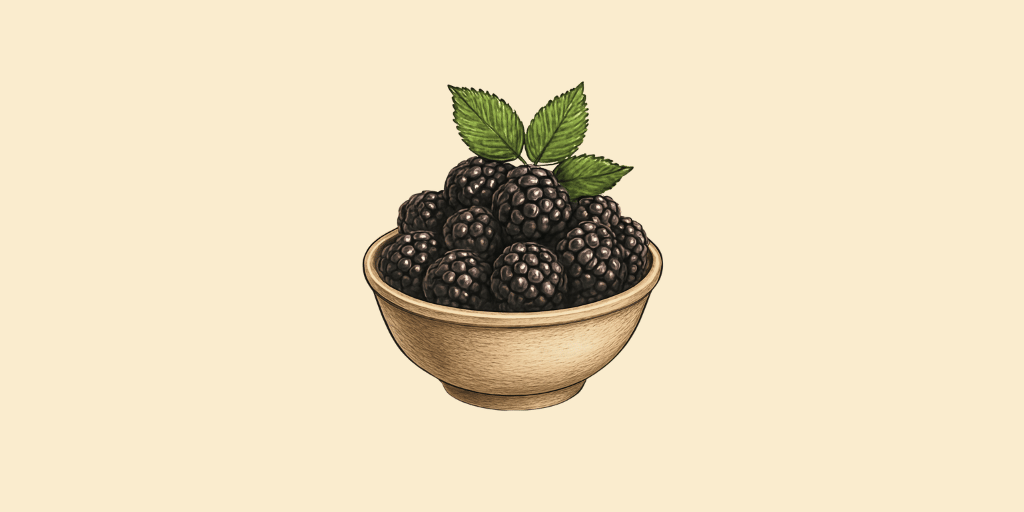
Sanskrit Name: Not listed in Classical Texts
Devanagari Name: काले बेर
Botanical Name: Rubus fruticosus
English Name: Blackberry
Description
Blackberry is a fruit that offers significant health, cosmetic, and nutritional advantages. It is commonly used in various culinary applications, including dishes, salads, and baked goods such as jams, snacks, and desserts.
Rich in vital nutrients and potent antioxidants like vitamin C, Blackberry supports the immune system. Regular consumption can also aid skin health due to its anti-aging effects. In Ayurveda, a herbal decoction made from Blackberry leaves can be consumed between meals to manage diarrhea thanks to its antimicrobial properties. This decoction can also alleviate throat discomfort when used as a mouth rinse.
Additionally, Blackberry exhibits anti-inflammatory properties that help reduce pain and swelling in affected areas. Daily intake of Blackberry can lower blood sugar levels because of its anti-diabetic effects.
Using a face mask made from Blackberry leaf powder can minimize wrinkles, acne, and boils, promoting overall skin health. Furthermore, Blackberry leaves facilitate the rapid healing of mouth ulcers due to their astringent qualities.
Benefits – through the lens of Ayurveda
In classical Ayurvedic texts, blackberries (Rubus fruticosus) are not directly mentioned, as they are not indigenous to India.
Main Chemical Constituents
- Anthocyanins
- Ellagic Acid
- Flavonoids (Quercetin, Kaempferol)
- Tannins
Nutritional Components
- Potassium
- Magnesium
- Vitamin C
- Vitamin K
- Folate (Vitamin B9)
- Dietary Fiber
- Niacin (Vitamin B3)
Medical Conditions(Relief)
- Blackberries are rich in vitamins C and K, which support immune function, promote healthy skin, and contribute to bone health.
- Blackberry provides relief for conditions like digestive issues such as constipation, indigestion, and bloating due to its high fiber content.
- It is rich in antioxidants, supporting heart health, boosting immunity, and promoting skin health.
- It also helps in managing blood sugar levels and reducing inflammation.
- Its antimicrobial properties help in fighting infections, and it supports detoxification.
- Additionally, blackberries support brain function, improve cognitive abilities, and have anti-aging properties due to their high polyphenol content.
Medical Conditions(Avoid)
- Blackberry should be avoided by individuals with allergies to berries or fruits in the Rosaceae family.
- People with digestive conditions such as acid reflux may experience discomfort from its acidity.
- Pregnant and breastfeeding women should consult a healthcare provider before consuming large quantities.
References
- Kaume L, Howard LR, Devareddy L. The blackberry fruit: a review on its composition and chemistry, metabolism and bioavailability, and health benefits. Journal of agricultural and food chemistry. 2012 Jun 13;60(23):5716-27.
- Rasheed HU, Nawaz H, Rehman R, Mushtaq A, Rashid U. The Blackberry: A Review on its Composition and Chemistry, Uses and Bioavailability and Potential Health Benefits. Int. J. Chem. Biochem. Sci. 2017;11:120-8.
- Robinson JA, Bierwirth JE, Greenspan P, Pegg RB. Blackberry polyphenols: Review of composition, quantity, and health impacts from in vitro and in vivo studies. Journal of Food Bioactives. 2020 Mar 31;9.
- M. Riaz, M. Ahmad, N. Rahman. (2011). Antimicrobial screening of fruit, leaves, root and stem of Rubus fruticosus. Journal of Medicinal Plants Research. 5(24): 5920-5924.
- H. Jiao, S.Y. Wang. (2000). Correlation of antioxidant capacities to oxygen radical scavenging enzyme activities in blackberry. Journal of Agricultural and Food Chemistry. 48(11): 5672-5676.
- G.D. Stoner, T. Chen, L.A. Kresty, R.M. Aziz, T. Reinemann, R. Nines. (2006). Protection against esophageal cancer in rodents with lyophilized berries: potential mechanisms. Nutrition and cancer. 54(1): 33-46.
- M. Ding, R. Feng, S.Y. Wang, L. Bowman, Y. Lu, Y. Qian, V. Castranova, B.-H. Jiang, X. Shi. (2006). Cyanidin-3 glucoside, a natural product derived from blackberry, exhibits chemopreventive and chemotherapeutic activity. Journal of Biological Chemistry. 281(25): 17359-17368.
- B.L. Halvorsen, K. Holte, M.C. Myhrstad, I. Barikmo, E. Hvattum, S.F. Remberg, A.-B. Wold, K. Haffner, H. Baugerød, L.F. Andersen. (2002). A systematic screening of total antioxidants in dietary plants. The Journal of nutrition. 132(3): 461-471.
- S.Y. Wang, L. Bowman, M. Ding. (2008). Methyl jasmonate enhances antioxidant activity and flavonoid content in blackberries (Rubus sp.) and promotes antiproliferation of human cancer cells. Food Chemistry. 107(3): 1261-1269.
- M. Marquina, G. Corao, L. Araujo, D. Buitrago, M.Sosa. (2002). Hyaluronidase inhibitory activity from the polyphenols in the fruit of blackberry (Rubus fruticosus B.). Fitoterapia. 73(7): 727-729.

