
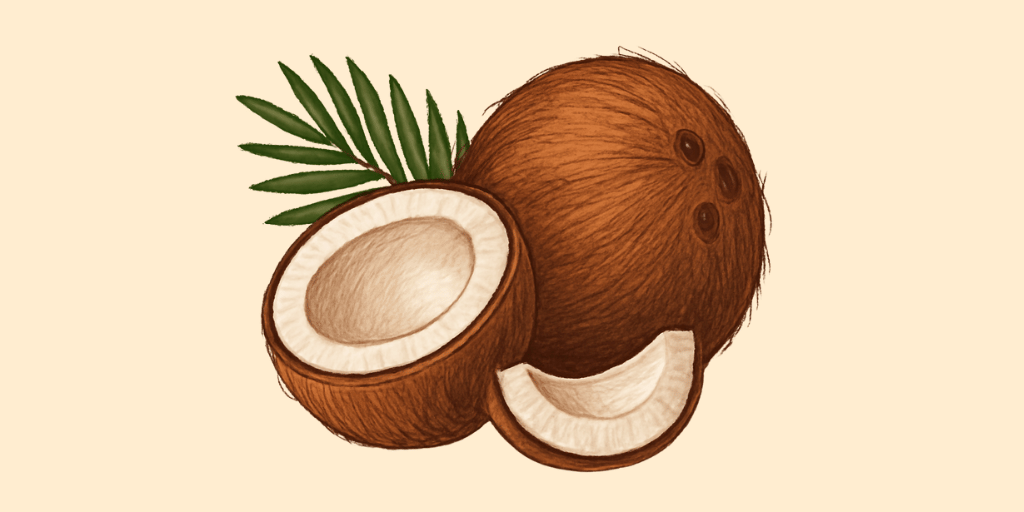
Sanskrit Name: Narikela
Devanagari Name: नारियल
Botanical Name: Cocos nucifera
English Name: Coconut
Description
Coconut, or Narikela, is a tropical superfood widely known for its health and skincare benefits. The coconut tree, often called the “tree of life,” produces versatile products like tender coconut water, virgin coconut oil, coconut milk, and desiccated coconut, all rich in essential nutrients and healthy fats.
Coconut oil is highly sought after for hair growth, skin moisturization, and oil pulling. Cold-pressed virgin coconut oil is commonly used for cooking, as it contains medium-chain triglycerides (MCTs) that support metabolism and heart health. Meanwhile, coconut water, low in calories yet high in electrolytes, is ideal for hydration and post-workout recovery.
From coconut biscuits to coconut chutney and coconut milk-based curries, the coconut plays a key role in both health and Indian cuisine. Products like coconut sugar, coconut cream, and coconut powder are also trending in plant-based and keto diets.
Benefits – through the lens of Ayurveda
- Snigdha (unctuous and moisturising)
- Sheetala (cooling in potency)
- Trishnahara (relieves excessive thirst)
- Balya (strength-promoting)
- Brimhana (nourishing and body-building)
- Pittahara (alleviates Pitta dosha)
- Keshya (promotes hair growth and scalp health)
- Raktaprasadana (purifies and nourishes blood)
Main Chemical Constituents
- Lauric acid
- Capric acid
- Caprylic acid
- Monolaurin
Nutritional Components
- Electrolytes (Potassium, Sodium, Magnesium)
- Healthy fats (MCTs)
- Dietary fiber
- Vitamin C
- Protein
- Iron
- Calcium
Medical Conditions(Relief)
- Coconut provides relief for conditions such as digestive disorders, dry skin, and dehydration.
- Coconut water is excellent for hydration and electrolyte balance.
- Coconut oil helps in managing skin conditions like eczema, acne, and dry skin.
- It also supports heart health, boosts immunity, and has antimicrobial properties.
Medical Conditions(Avoid)
- Coconut should be avoided by individuals with coconut allergies or those with a history of coconut sensitivities.
- People with high cholesterol should consume coconut oil in moderation, as it is high in saturated fats.
- Pregnant and breastfeeding women should consult their healthcare provider before using coconut oil in large quantities.
References
- Charak Samhita of Agnivesha, Charak, Dridhabala edited with ‘Vidyamanorama’ hindi commentary by Acharya Vidyadhar Shukla and prof. Ravi Dutt Tripathi, Chaukhamba Sanskrit Pratishthan, Delhi, edition, 2006; 1
- Kaiyadeva Nighantuh Prof. Priyavrata Sharma and Dr. guru Prasada Sharma Chaukhambha Orientalia Varanasi Reprint, 2013.
- Nighantu aadarsa vol-2 by Bapalala. G. Vaidya Chaukhambha Bharati Academy reprint, 2009.
- Haritakyadi Nighantu, edited by Khemraj Shrikrishnadas, Mumbai, 2000.
- Bhavaprakasa Nighantu of Sri Bhavamisra, commentary by Padmshri prof. K. C. Chunekar edited by Dr. G. S. Pandey. Chaukhambha Bharati Academy Varanasi. Reprint,
- Susruta Samhita of Maharsi-Susruta edited with Ayurveda-Tattva-Sandipika by Kaviraj Ambikadutta Shastri Part-1 Chaukhambha Sanskrit sansthan Varanasi. Reprint, 2017
- Agyemang-Yeboah F. Health benefits of coconut (Cocos nucifera Linn.) seeds and coconut consumption. InNuts and seeds in health and disease prevention 2011 Jan 1 (pp. 361-367). Academic Press.
- Enig MG. Coconut: in support of good health in the 21st century. In36th meeting of APCC 1999 Sep.

