
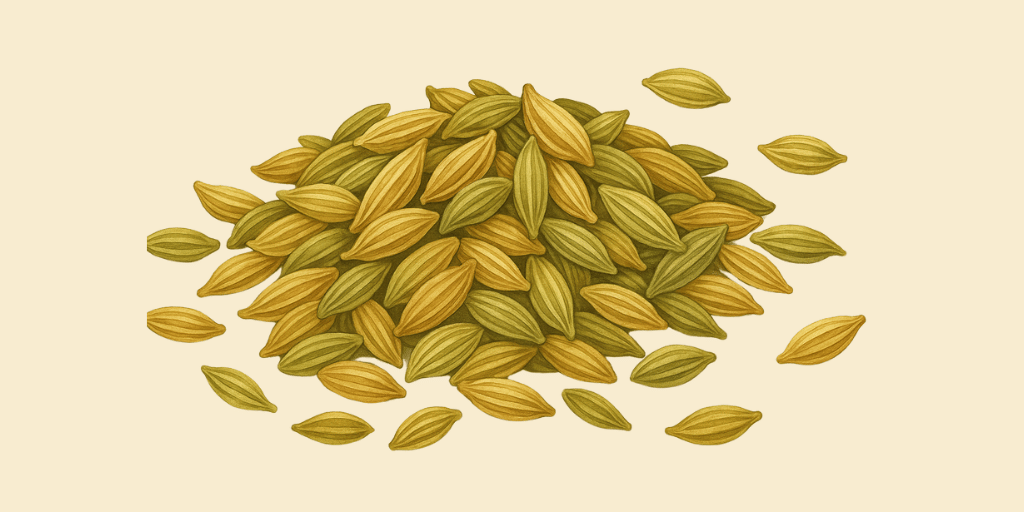
Sanskrit Name: Madhurika / Mishreya
Devanagari Name: सौंफ
Botanical Name: Foeniculum vulgare
English Name: Fennel Seeds
Description
Fennel seeds, widely known as Saunf (सौंफ in Hindi), are a flavorful and aromatic spice commonly used in Indian households for culinary and medicinal purposes. Unlike most spices, fennel has a sweet, slightly bitter taste and a naturally cooling effect on the body, making it unique in Ayurveda.
They are rich in nutrients like Vitamin C, potassium, and fiber, and contain the powerful compound anethole, which gives fennel its distinct aroma and medicinal potency. These seeds are especially consumed after meals to aid digestion, reduce bloating, and freshen the breath.
In Ayurveda, fennel is praised for its Deepana (appetizing) and Pachana (digestive) qualities. It is known to balance Vata and Pitta doshas, calm the digestive fire (Agni), and support women’s health by relieving menstrual cramps and promoting lactation in nursing mothers.
Fennel seed water, made by soaking fennel seeds in water overnight, is widely used for weight loss, eye inflammation, and internal detoxification. It is gentle on the system, making it suitable even for children and the elderly.
Benefits – through the lens of Ayurveda
- Deepana-Pachana (Appetizer & Digestive)
- Agnivardhaka (Improves digestive fire)
- Stanyavardhaka (Promotes breast milk production)
- Shothahara (Reduces inflammation)
- Mutrala (Mild diuretic)
- Rochana (Improves appetite)
- Hridaya (Good for the heart)
- Vata-Pitta Shamaka (Pacifies Vata and Pitta)
Main Chemical Constituents
- Anethole
- Fenchone
- Flavonoids (such as Quercetin)
- Volatile Oils
Nutritional Components
- Vitamin C
- Potassium
- Calcium
- Magnesium
- Iron
- Dietary fiber
Medical Conditions(Relief)
- Fennel Seeds provides relief for digestive issues like bloating, gas, indigestion, and constipation.
- Fennel seeds are beneficial for reducing menstrual cramps, promoting hormonal balance, and supporting lactation.
- They help in detoxification, reducing inflammation, and promoting heart health by lowering cholesterol levels.
Medical Conditions(Avoid)
- Avoid excess consumption to prevent digestive discomfort.
- Avoid self-medication; always seek physician guidance.
- Pregnant and lactating women should consult a healthcare provider.
References
- Bhavaprakasa Nighantu of Sri Bhavamisra, commentary by Padmashri prof. K. C. Chunekar edited by Dr. G. S. Pandey. Chaukhambha Bharati Academy Varanasi. Reprint, 2015.
- Shastry JLN, Ayurvedoktha Aushadha Niruktamala (ed.1), Varanasi, Chawkambha Orienatlia, 2001; p.82
- Acharya YT, editor (5 ed.), Commentary Nibandha Sangraha on Sushruta samhita of Sushruta. Chikitsastana; Kushthachikitsa: Chapter 9, verse 34. Varanasi: Chaukambha Orientalia,1992; p 445
- Sharma PV, Dravyaguna Vijnana.ed.14. Varanasi: Chawkambha Bharati Academy; 1993: p 192
- Rafieian F, Amani R, Rezaei A, Karaça AC, Jafari SM. Exploring fennel (Foeniculum vulgare): Composition, functional properties, potential health benefits, and safety. Critical Reviews in Food Science and Nutrition. 2024 Aug 6;64(20):6924-41.
- Rathore SS, Saxena SN, Singh B. Potential health benefits of major seed spices. Int J Seed Spices. 2013 Jul;3(2):1-2.
- Sass C. Health Benefits of Fennel.

