
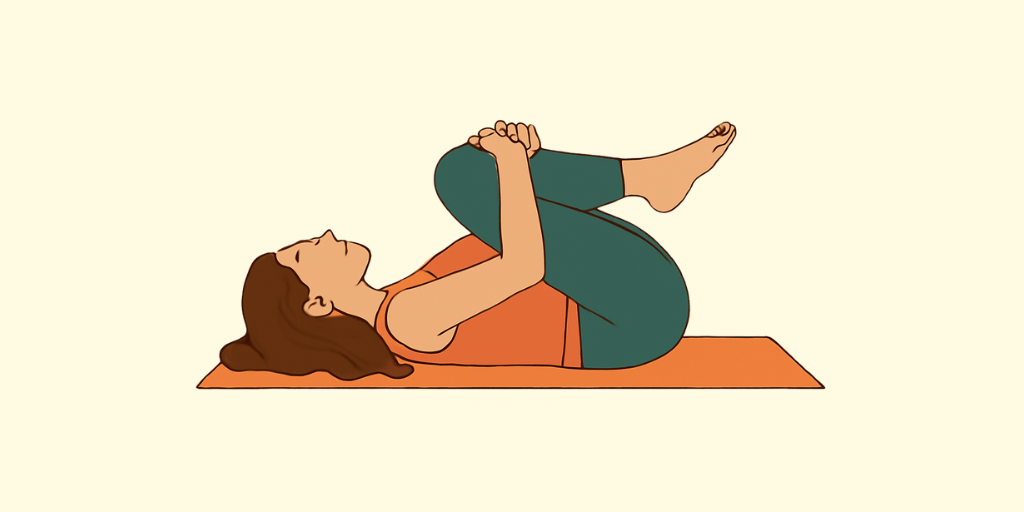
Sanskrit Name: पवनमुक्तासन
English Name: Wind-Relieving Pose
Description
Pawanmuktasana, known as the Wind-Relieving Pose, is a straightforward yet powerful yoga position that aids in releasing trapped gas, enhancing digestion, and alleviating lower back strain. The term originates from Sanskrit, where “Pawan” (पवन) translates to “wind,” “Mukta” (मुक्त) means “release,” and “Asana” (आसन) signifies “pose”.
This asana is especially advantageous for individuals experiencing indigestion, bloating, or mild constipation. This position stimulates the digestive organs, boosts circulation, and alleviates abdominal discomfort. It is a pose suitable for beginners, making it accessible to individuals of varying fitness levels.
How to Do
Here are the steps to do Pawanmuktasana (Wind-Relieving Pose).
- Lie Down on Your Back: Start by lying flat on your back with your legs extended straight and your arms by your sides, palms facing down.
- Bend Your Knees: Bend both knees and bring them toward your chest. Keep your feet together and your knees close to each other.
- Hug Your Knees: Wrap your arms around your knees and pull them closer towards your chest. Use your hands to hold your shins or the back of your thighs. Ensure your back is flat on the ground.
- Lift Your Head and Shoulders: Inhale, and as you exhale, lift your head and shoulders off the floor, bringing your forehead closer to your knees. Tuck your chin toward your chest for added compression.
- Hold the Pose: Stay in this position for 15-30 seconds, breathing deeply and steadily. You should feel a gentle compression in your abdomen and a release of any gas in the digestive system.
- Release the Pose: To release, slowly lower your head and shoulders back down to the floor and straighten your legs back out.
- Rest in Savasana: After releasing, rest in Savasana (Corpse Pose) for a few moments to relax.
If you find it difficult to hold the pose initially, you can keep the head on the floor and simply hug your knees into your chest until you gain more flexibility and strength.
Benefits
- Pawanmuktasana, also known as the Wind-Relieving Pose, can be beneficial for various medical conditions.
- It aids in relieving digestive issues such as bloating and gas by promoting the expulsion of trapped air.
- This asana also helps alleviate lower back pain and enhances flexibility in the spine.
- Additionally, it can improve circulation and reduce stress, contributing to overall mental well-being.
- Regular practice may support those with respiratory conditions by encouraging deeper breathing and lung capacity.
Medical Conditions(Relief)
- Digestive Health: This asana helps relieve gas and bloating by promoting the movement of air through the digestive tract, thus aiding digestion.
- Lower Back Relief: By stretching the lower back and hip muscles, it can alleviate tension and discomfort in these areas.
- Stress Reduction: The pose encourages relaxation and mindfulness, which can help reduce stress and anxiety levels.
- Improved Circulation: It enhances blood flow to the abdominal organs, promoting overall health and vitality.
- Strengthening Core Muscles: Engaging the core during the pose helps strengthen abdominal muscles, contributing to better posture and stability.
Medical Conditions(Avoid)
- Severe Back Issues: Individuals with significant spinal injuries or chronic back pain may exacerbate their condition.
- Abdominal Surgery: Those who have recently undergone abdominal surgery should refrain from this pose to prevent strain.
- Hernia: People with hernias should avoid this asana to prevent worsening their condition.
- Pregnancy: Pregnant individuals should avoid this pose, especially in later trimesters, as it may put pressure on the abdomen.
- Knee Injury: Anyone with severe knee injuries or conditions like arthritis should avoid this pose to prevent aggravation.
- Recent Hip Surgery: Individuals recovering from hip surgery should not practice this asana to avoid strain on the hip joint.
References
- Patanjali, Yoga Sutras of Patanjali, Commentary by Swami Sivananda. Divine Life Society, 1990; p. 58.
- Swatmarama, Hatha Yoga Pradipika, Edited by Swami Muktibodhananda. Bihar School of Yoga, 1998; p. 72.
- Sushruta, Sushruta Samhita, Commentary by Acharya Y.T. (5th ed.). Varanasi: Chaukambha Orientalia, 1992; p. 445.
- Krishnamacharya, Yoga Makaranda, Translated by A.G. Mohan. Krishnamacharya Yoga Mandiram, 2012; p. 103.
- Iyengar B.K.S., Light on Yoga. HarperCollins Publishers, 1966; p. 102.
- Desikachar T.K.V., The Heart of Yoga: Developing a Personal Practice. Inner Traditions, 1995; p. 88.
- Jois K. Pattabhi, Yoga Mala. The Yoga Institute, 2002; p. 120.
- Swami Vivekananda, Raja Yoga. Advaita Ashrama, 1993; p. 61.
- Swami Sivananda, The Science of Pranayama. Divine Life Society, 1951; p. 99.
- Sivananda Yoga Vedanta Centres, Yoga and Health. Sivananda Publications, 2005; p. 45.

