
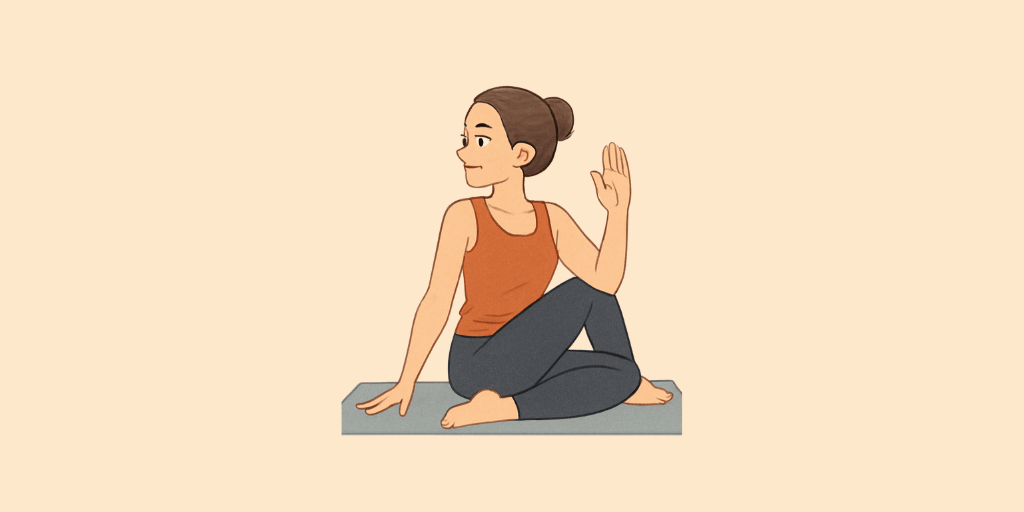
Sanskrit Name: वक्रासन
English Name: Twisted Pose
Description
Vakrasana, referred to as the Twisted Pose, is an accessible seated spinal twist that aids in enhancing flexibility, digestion, and correcting posture. The term originates from Sanskrit, where “Vakra” (वक्र) translates to “twisted” or “curved,” and “Asana” (आसन) means “pose.” This asana serves as a beginner-friendly option compared to more complex twists like Ardha Matsyendrasana and is frequently incorporated in Hatha Yoga for promoting spinal health and detoxification.
Additionally, it alleviates back stiffness, enhances posture, and lowers stress levels by soothing the nervous system. Vakrasana has been integral to Hatha Yoga for centuries, focusing on spinal wellness and detoxification. Twisting poses such as this are thought to harmonize the nervous system, enhance digestion, and eliminate toxins.
Ancient yogis engaged in spinal twists to promote energy flow and maintain a youthful, resilient spine.These benefits make Vakrasana a valuable addition to a holistic wellness routine.
How to Do
Here are the steps to do Vakrasana (Twisted Pose).
- Sit on the Floor: Start by sitting on the floor with your legs extended straight in front of you. Keep your spine straight and your feet together.
- Bend Your Right Knee: Bend your right knee and place your right foot flat on the floor, just outside of your left knee. Your right knee should be pointing upwards.
- Position Your Left Arm: Place your left hand on the floor behind you for support. Your fingers should be pointing towards your back, and your elbow should be slightly bent. This will help you maintain balance as you twist.
- Place Your Right Hand on Your Left Knee: Inhale and then exhale as you place your right hand on your left knee. This will assist in the twist as you gently rotate your torso to the right.
- Twist Your Upper Body: On your next inhale, lengthen your spine. As you exhale, twist your torso to the right, gently bringing your left shoulder back and your chest open. Keep your head aligned with your spine and look over your right shoulder.
- Deepen the Twist: With each inhale, lengthen your spine, and with each exhale, deepen the twist slightly. Avoid forcing the twist and move slowly, listening to your body.
- Hold the Pose: Stay in the twisted position for 15–30 seconds, breathing deeply and steadily. Focus on keeping your spine straight and maintaining the twist with ease.
- Release the Pose: To release, inhale and slowly return your torso to the center, uncross your legs, and extend them out in front of you.
- Repeat on the Other Side: For the second side, bend your left knee and place your left foot outside your right knee. Repeat the same steps to twist to the left.
Keep the movement slow and controlled to avoid straining the back.
Benefits
- Vakrasana, or the Twisted Pose, can be beneficial for various medical conditions.
- It aids in improving digestion by stimulating the abdominal organs, which can help alleviate issues like constipation and indigestion.
- Additionally, this asana enhances spinal flexibility and strength, which may assist individuals with back pain or stiffness.
- It also promotes better circulation and can help in reducing stress and anxiety, contributing to overall mental well-being.
- Furthermore, practicing Vakrasana can support detoxification by encouraging the body to eliminate toxins more effectively.
Medical Conditions(Relief)
- Improves Digestion: The twisting motion stimulates abdominal organs, enhancing digestion and alleviating issues like constipation.
- Spinal Flexibility: It promotes spinal flexibility and strength, which can help alleviate back pain and improve posture.
- Detoxification: The asana aids in detoxifying the internal organs by facilitating blood flow and promoting the release of toxins.
- Relieves Stress: Practicing Vakrasana can help reduce stress and anxiety, promoting mental clarity and relaxation.
- Enhances Respiratory Function: The pose encourages deep breathing, which can improve lung capacity and overall respiratory health.
Medical Conditions(Avoid)
- Spinal Disorders: Individuals with herniated discs, severe back pain, or spinal injuries should avoid this asana as it involves twisting the spine, which could exacerbate their condition.
- Pregnancy: Pregnant women should refrain from performing Vakrasana, especially in the later stages, due to the pressure it places on the abdomen and the potential discomfort it may cause.
- Recent Surgery: Those who have undergone abdominal or spinal surgery should avoid this asana until fully healed, as twisting movements can strain the surgical site.
- Severe Digestive Issues: Individuals with conditions like ulcers, severe acid reflux, or inflammatory bowel diseases may find that the twisting motion aggravates their symptoms.
- Hernia: People with any type of hernia should avoid Vakrasana, as the twisting action can put additional strain on the affected area.
- Knee Problems: Those with severe knee pain or injuries may find this asana uncomfortable and should avoid it to prevent further injury.
- Cardiovascular Issues: Individuals with serious heart conditions should consult a healthcare provider before performing this asana, as it can increase heart rate and blood pressure during the twist.
References
- Patanjali, Yoga Sutras of Patanjali, Commentary by Swami Sivananda. Divine Life Society, 1990; p. 58.
- Swatmarama, Hatha Yoga Pradipika, Edited by Swami Muktibodhananda. Bihar School of Yoga, 1998; p. 72.
- Sushruta, Sushruta Samhita, Commentary by Acharya Y.T. (5th ed.). Varanasi: Chaukambha Orientalia, 1992; p. 445.
- Krishnamacharya, Yoga Makaranda, Translated by A.G. Mohan. Krishnamacharya Yoga Mandiram, 2012; p. 103.
- Iyengar B.K.S., Light on Yoga. HarperCollins Publishers, 1966; p. 102.
- Desikachar T.K.V., The Heart of Yoga: Developing a Personal Practice. Inner Traditions, 1995; p. 88.
- Jois K. Pattabhi, Yoga Mala. The Yoga Institute, 2002; p. 120.
- Swami Vivekananda, Raja Yoga. Advaita Ashrama, 1993; p. 61.
- Swami Sivananda, The Science of Pranayama. Divine Life Society, 1951; p. 99.
- Sivananda Yoga Vedanta Centres, Yoga and Health. Sivananda Publications, 2005; p. 45.

