
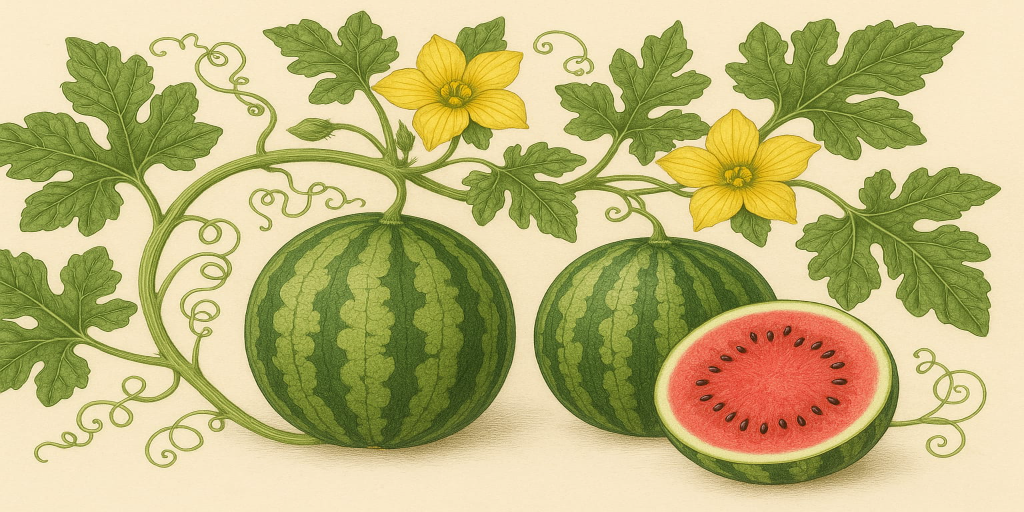
Sanskrit Name: Kalinda
Devanagari Name:तरबूज
Botanical Name: Citrullus lanatus
English Name: Watermelon
Description
Watermelon is a large, juicy fruit of the Cucurbitaceae family, widely cultivated in tropical and subtropical regions. Known for its red or yellow pulp, it contains about 92% water, making it one of the most hydrating fruits. It is consumed fresh, in fruit salads, juices, milkshakes, and mocktails, and is especially popular in summer for its cooling properties.
It is available in varieties such as yellow watermelon, seedless watermelon, and even square watermelon. Watermelon is low in calories, has a low glycemic index, and is rich in essential nutrients such as lycopene, citrulline, potassium, magnesium, and vitamins A and C. Its seeds are also used as a protein- and mineral-rich food ingredient.
Watermelon is also applied in skin care for its hydrating, anti-inflammatory, and antioxidant effects. It helps manage skin dryness, sun damage, and acne. The juice and pulp are often used for external applications.
The fruit is often recommended for weight loss, digestion, and detoxification. It is especially suitable for hot climates and is widely consumed during summer, pregnancy, and fitness diets.
Benefits – through the lens of Ayurveda
- Trishna-hara (relieves excessive thirst)
- Sheetala (cooling in nature)
- Daha-pachana (reduces burning sensation)
- Mutrala (diuretic; promotes healthy urination)
- Mridu (soft and easy to digest)
- Pittahara (alleviates excess Pitta)
Main Chemical Constituents
- Lycopene
- Citrulline
- Beta-carotene
- Vitamin C
- Flavonoids
- Phenolic acids
Nutritional Components
- Water (92%)
- Vitamin A
- Vitamin C
- Magnesium
- Potassium
- Natural sugars
- Citrulline
- Dietary fiber
Medical Conditions(Relief)
- Watermelon is a hydrating fruit that provides relief from dehydration, particularly during hot weather.
- It is rich in antioxidants like lycopene, which supports heart health, reduces oxidative stress, and prevents damage from free radicals.
- Watermelon is also beneficial for digestive health, helping to relieve constipation and promote regular bowel movements due to its high water and fiber content.
- It is low in calories, making it a great snack for weight management and hydration.
- Watermelon is also used to regulate blood sugar levels, reduce inflammation, and provide a refreshing boost of energy.
Medical Conditions(Avoid)
- Watermelon should be consumed cautiously by individuals with low blood sugar or those who are diabetic, as it may cause a sudden spike in blood sugar levels.
- People with kidney disease should limit watermelon intake due to its potassium content, which may strain the kidneys.
- Pregnant women should consult their healthcare provider if they have concerns about consuming watermelon during pregnancy.
Refereces
- Charak Samhita of Agnivesha, Charak, Dridhabala edited with ‘Vidyamanorama’ hindi commentary by Acharya Vidyadhar Shukla and prof. Ravi Dutt Tripathi, Chaukhamba Sanskrit Pratishthan, Delhi, edition, 2006; 1
- Kaiyadeva Nighantuh Prof. Priyavrata Sharma and Dr. guru Prasada Sharma Chaukhambha Orientalia Varanasi Reprint, 2013.
- Nighantu aadarsa vol-2 by Bapalala. G. Vaidya Chaukhambha Bharati Academy reprint, 2009.
- Haritakyadi Nighantu, edited by Khemraj Shrikrishnadas, Mumbai, 2000.
- Bhavaprakasa Nighantu of Sri Bhavamisra, commentary by Padmshri prof. K. C. Chunekar edited by Dr. G. S. Pandey. Chaukhambha Bharati Academy Varanasi. Reprint,
- Susruta Samhita of Maharsi-Susruta edited with Ayurveda-Tattva-Sandipika by Kaviraj Ambikadutta Shastri Part-1 Chaukhambha Sanskrit sansthan Varanasi. Reprint, 2017
- Maoto MM, Beswa D, Jideani AI. Watermelon as a potential fruit snack. International Journal of food properties. 2019 Jan 1;22(1):355-70.
- Ijaz A, Tufail T, Saeed F, Afzaal M, Shahid MZ, Suleria HA. Health benefits of watermelon (Citrullus Lanatus). InBioactive Compounds from Multifarious Natural Foods for Human Health 2022 Aug 1 (pp. 77-98). Apple Academic Press.
- Perkins-Veazie P. Cucurbits, watermelon, and benefits to human health. InIV International Symposium on Cucurbits 871 2009 Sep 21 (pp. 25-32).

