
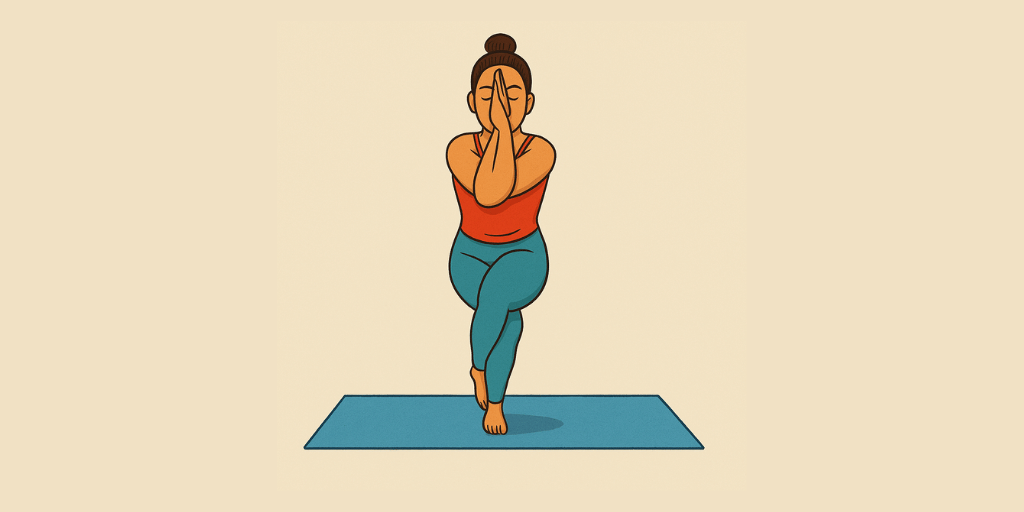
Sanskrit Name: गरुडासन
English Name: Eagle Pose
Description
Garudasana, commonly referred to as Eagle Pose, is a yoga position that requires balancing on one leg while wrapping the opposite leg and arm around the body. In Sanskrit, Garuda (गरुड) signifies eagle, a mythical bird, and Asana (आसन) means pose or posture, thus translating Garudasana to Eagle Pose. This name symbolizes the shape and energy of the pose, resembling the extended wings of an eagle and the strength and balance of this magnificent bird.
Inspired by Garuda, the legendary bird in Hindu mythology, known as Lord Vishnu’s vehicle, this pose embodies Garuda’s attributes: strength, concentration, and elegance. It challenges your body’s stability and flexibility while enhancing mental clarity. The essence of the pose lies in discovering your center and embracing the power and grace inherent in this profound balancing stretch.
How to Do
Here are the steps to do Garudasana (Eagle Pose).
- Start in Mountain Pose (Tadasana): Stand tall with your feet together, arms by your sides, and your weight evenly distributed on both feet.
- Bend Your Knees Slightly: Begin to bend your knees slightly and lift your right leg off the floor.
- Wrap Your Right Leg Around Your Left Leg: Cross your right thigh over your left and hook the top of your right foot around the back of your left calf (or, if you can, the ankle). If your foot doesn’t reach the calf, don’t worry; just keep it raised.
- Extend Your Arms in Front of You: Stretch your arms straight out in front of you at shoulder height, palms facing down.
- Cross Your Right Arm Over Your Left: Cross your right arm under your left arm and try to bring your palms together. If this is difficult, you can also clasp your opposite wrists or hold onto your upper arms.
- Bring Your Elbows Down: Bend your elbows slightly so that your forearms are parallel to the floor. Keep your elbows close to each other and your wrists flexed.
- Lift Your Elbows and Hold the Pose: Inhale and lengthen your spine, lifting your elbows slightly. Exhale and try to deepen your bend, engaging your core to help with balance.
- Focus and Hold the Pose: Hold the position for 15–30 seconds, breathing deeply and steadily. Focus on keeping your balance while maintaining a straight posture. Keep your gaze fixed on one point ahead to help maintain stability.
- Release the Pose: To release, slowly unwind your arms and legs. Gently bring your arms and legs back to the neutral standing position.
- Repeat on the Other Side: Now switch sides: bend your left leg, wrap your left thigh over your right leg, and cross your left arm over your right. Repeat the steps for the opposite side.
If you find it difficult to balance, you can practice near a wall or use a chair for support until you build strength and stability in the pose.
Benefits
- Garudasana, or Eagle Pose, can be beneficial for several medical conditions.
- It aids in improving balance and coordination, which is helpful for those with neurological disorders.
- The pose enhances flexibility in the joints, making it advantageous for individuals with arthritis.
- Additionally, it promotes better respiratory function, assisting those with asthma or other respiratory issues.
- Practicing Garudasana can also alleviate stress and anxiety, contributing to overall mental health improvements.
Medical Conditions(Relief)
- Improved Balance and Coordination: The pose enhances proprioception and stability, which can help in daily activities and sports.
- Increased Flexibility: It stretches the shoulders, upper back, and legs, promoting overall flexibility.
- Stress Relief: The pose encourages deep breathing, which can reduce stress and anxiety levels.
- Enhanced Concentration: The focus required in maintaining balance fosters mental clarity and concentration.
- Joint Health: It aids in the lubrication of the joints, particularly the knees and ankles, which can alleviate stiffness.
- Detoxification: The compression of internal organs during the pose can stimulate digestion and promote detoxification.
Medical Conditions(Avoid)
- Knee Injuries: Individuals with knee problems, such as ligament tears or severe arthritis, may experience increased strain and pain during this pose.
- Ankle Issues: Those with sprains or fractures in the ankle should refrain from practicing Garudasana, as it requires balance and stability that could exacerbate the injury.
- Hip Problems: Conditions like hip bursitis or severe hip pain can be aggravated by the twisting and bending required in this pose.
- Back Pain: People with chronic back pain or conditions like herniated discs should avoid this pose to prevent further discomfort or injury.
- Pregnancy: Pregnant individuals should generally avoid poses that involve deep twists or balancing on one leg, as they can create instability and strain.
- Recent Surgery: Anyone recovering from surgery, especially in the lower body, should avoid this pose until fully healed and cleared by a healthcare professional.
References
- Patanjali, Yoga Sutras of Patanjali, Commentary by Swami Sivananda. Divine Life Society, 1990; p. 58.
- Swatmarama, Hatha Yoga Pradipika, Edited by Swami Muktibodhananda. Bihar School of Yoga, 1998; p. 72.
- Sushruta, Sushruta Samhita, Commentary by Acharya Y.T. (5th ed.). Varanasi: Chaukambha Orientalia, 1992; p. 445.
- Krishnamacharya, Yoga Makaranda, Translated by A.G. Mohan. Krishnamacharya Yoga Mandiram, 2012; p. 103.
- Iyengar B.K.S., Light on Yoga. HarperCollins Publishers, 1966; p. 102.
- Desikachar T.K.V., The Heart of Yoga: Developing a Personal Practice. Inner Traditions, 1995; p. 88.
- Jois K. Pattabhi, Yoga Mala. The Yoga Institute, 2002; p. 120.
- Swami Vivekananda, Raja Yoga. Advaita Ashrama, 1993; p. 61.
- Swami Sivananda, The Science of Pranayama. Divine Life Society, 1951; p. 99.
- Sivananda Yoga Vedanta Centres, Yoga and Health. Sivananda Publications, 2005; p. 45.

