
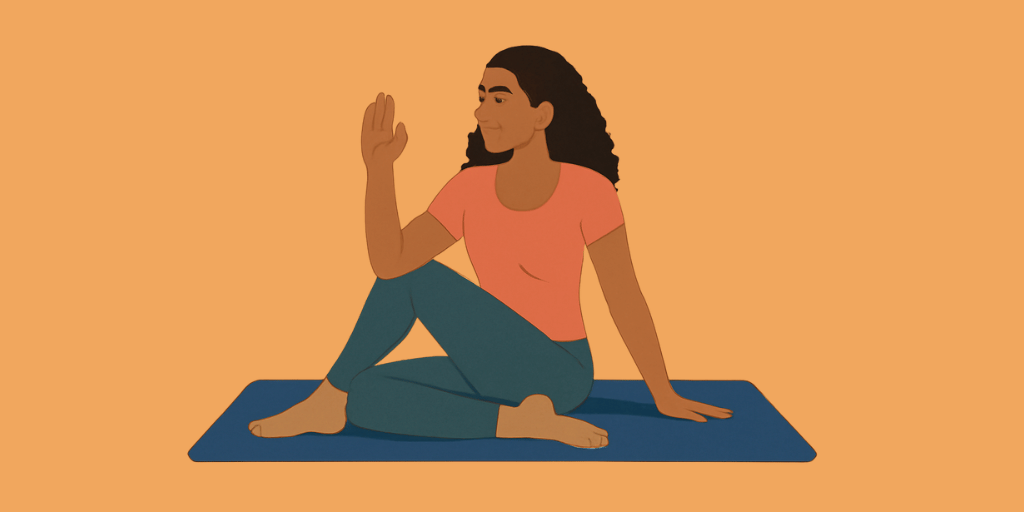
Sanskrit Name: अर्धमत्स्येन्द्रासन
English Name: Half Spinal Twist Pose
Description
Ardhamatsyendrasana, also known as Half Lord of the Fishes Pose, involves a gentle twist that helps alleviate tension while stretching the spine, shoulders, and hips. The term comes from Sanskrit: Ardha (अर्ध) means half, Matsya (मछ) translates to fish, Indra (इन्द्र) signifies lord or king, and Asana (आसन) means pose or posture. This name pays tribute to the revered sage Matsyendra, credited with uncovering the principles of yoga and meditation. The twisting motion of this pose mirrors the fluidity of a fish, representing adaptability and grace.
Ardhamatsyendrasana is associated with Matsyendra, a legendary yogi believed to be the originator of Hatha Yoga and the mentor of Gorakhnath. Often depicted as a fish, the title “Lord of the Fishes” derives from the Sanskrit words Matsya (meaning “fish”) and Indra (meaning “lord” or “king”). This pose also provides a massage to the internal organs, enhancing digestion and alleviating issues like constipation or bloating, while promoting better posture and spinal alignment through increased awareness of movement.
How to Do
Here are the steps to do Ardhamatsyendrasana (Half Lord of the Fishes Pose).
- Sit on the Floor: Begin by sitting on the floor with your legs extended straight in front of you. Keep your spine straight and your legs together.
- Bend Your Right Knee: Bend your right knee and place your right foot outside your left thigh, close to your hip. The sole of the right foot should be flat on the floor.
- Bend Your Left Knee: Bend your left knee and tuck your left foot under your right hip or place it beside your right knee, with the sole of the left foot facing your right hip.
- Align Your Spine: Sit up straight, ensuring your spine is long and tall. Keep your shoulders relaxed.
- Place Your Left Hand Behind You: Place your left hand on the floor behind your back, fingers pointing towards your spine. This hand will provide support as you twist.
- Place Your Right Arm Over Your Left Knee: Inhale and raise your right arm up toward the ceiling. On the exhale, bring your right arm across your body, placing your elbow on the outside of your left knee.
- Twist Your Upper Body: Inhale and lengthen your spine. Exhale and gently twist your torso to the left, turning your head and gaze over your left shoulder.
- Deepen the Twist: With each inhale, lengthen your spine. With each exhale, gently deepen the twist, ensuring you’re not overstraining your neck or back.
- Hold the Pose: Hold the pose for 15-30 seconds, breathing deeply and evenly. Focus on maintaining a long spine and a gentle twist.
- Release the Pose: To release, inhale and gently unwind your torso back to the center. Straighten your legs and relax in Savasana (Corpse Pose) or any comfortable position.
- Repeat on the Other Side: Switch sides by bending your left knee, placing your left foot outside your right thigh, and repeating the steps.
If you’re new to this pose, you can sit on a cushion or blanket to raise your hips and make the twist more accessible. Avoid forcing the twist; it should feel comfortable and gradual.
Benefits
- Ardhamatsyendrasana, or Half Lord of the Fishes Pose, can be beneficial for several medical conditions.
- It aids in improving spinal flexibility and alleviating back pain by gently stretching the spine.
- This asana also promotes digestion and can help relieve issues like constipation and bloating.
- Additionally, it may support respiratory health by expanding the chest and enhancing lung capacity.
- People with sciatica may find relief through this pose, as it can help in reducing nerve tension.
- Furthermore, it encourages mental clarity and can assist in managing stress and anxiety levels.
Medical Conditions(Relief)
- Spinal Flexibility: This asana enhances the flexibility of the spine, promoting better posture and reducing stiffness.
- Digestive Health: The twisting motion stimulates the abdominal organs, improving digestion and alleviating issues like constipation.
- Detoxification: The compression of the abdominal area aids in detoxifying the liver and kidneys, enhancing overall bodily functions.
- Stress Relief: Practicing this pose can help reduce stress and anxiety, promoting mental clarity and emotional balance.
- Sciatica Relief: It can alleviate symptoms of sciatica by stretching the lower back and hip muscles.
- Improved Circulation: The pose encourages blood flow to the spine and surrounding areas, aiding in overall circulation.
Medical Conditions(Avoid)
- Spinal Disorders: Individuals with severe spinal issues, such as herniated discs or spondylitis, may exacerbate their condition due to the twisting motion involved in this asana.
- Pregnancy: Pregnant women should avoid this pose, especially during the later stages, as the deep twisting can put pressure on the abdomen.
- Recent Surgery: Those who have undergone abdominal or spinal surgery should refrain from practicing this pose until fully healed, as it can strain the surgical site.
- Digestive Disorders: Individuals with serious digestive issues, such as ulcers or inflammatory bowel disease, might find that this pose aggravates their symptoms.
- Knee or Hip Injuries: If there are injuries or chronic pain in the knees or hips, the position may cause discomfort or further injury.
- Severe Headaches or Migraines: Practicing this pose during a headache or migraine may intensify the pain due to the pressure and strain on the neck.
- Carpal Tunnel Syndrome: Those with this condition should avoid the pose, as the wrist position can exacerbate symptoms.
References
- Patanjali, Yoga Sutras of Patanjali, Commentary by Swami Sivananda. Divine Life Society, 1990; p. 58.
- Swatmarama, Hatha Yoga Pradipika, Edited by Swami Muktibodhananda. Bihar School of Yoga, 1998; p. 72.
- Sushruta, Sushruta Samhita, Commentary by Acharya Y.T. (5th ed.). Varanasi: Chaukambha Orientalia, 1992; p. 445.
- Krishnamacharya, Yoga Makaranda, Translated by A.G. Mohan. Krishnamacharya Yoga Mandiram, 2012; p. 103.
- Iyengar B.K.S., Light on Yoga. HarperCollins Publishers, 1966; p. 102.
- Desikachar T.K.V., The Heart of Yoga: Developing a Personal Practice. Inner Traditions, 1995; p. 88.
- Jois K. Pattabhi, Yoga Mala. The Yoga Institute, 2002; p. 120.
- Swami Vivekananda, Raja Yoga. Advaita Ashrama, 1993; p. 61.
- Swami Sivananda, The Science of Pranayama. Divine Life Society, 1951; p. 99.
- Sivananda Yoga Vedanta Centres, Yoga and Health. Sivananda Publications, 2005; p. 45.

