
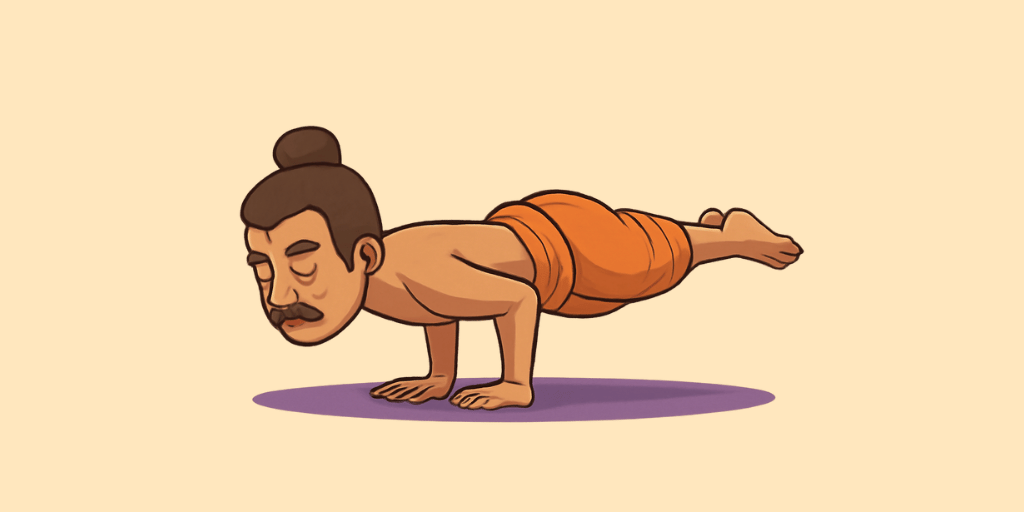
Sanskrit Name: मयूरासन
English Name: Peacock Pose
Description
Mayurasana, known as Peacock Pose, is a highly demanding posture that challenges your strength, balance, and concentration. In this pose, your body resembles a peacock displaying its feathers, embodying both elegance and power. The term Mayura (मयूर) translates to peacock in Sanskrit, while Asana (आसन) refers to pose or posture, making Mayurasana the “Peacock Pose.”
Originating from traditional Hatha Yoga, this pose is typically practiced by advanced yogis seeking to extend their capabilities. Some traditions suggest that this pose is inspired by the peacock’s majestic ability to fan its feathers and stand confidently.
Practicing Mayurasana is thought to purify the body, boost vitality, and improve both mental and physical clarity. It has been an integral part of yogic teachings for centuries, often aimed at enhancing strength and focus, as well as promoting digestion and the health of internal organs.
How to Do
Here are the steps to do Mayurasana (Peacock Pose).
- Start in a Squatting Position: Begin by sitting on your knees, with your knees wide apart and your feet flat on the floor, toes pointing behind you.
- Place Your Hands on the Floor: Place your hands on the floor in front of you, slightly wider than shoulder-width apart. Your fingers should be spread wide to support your weight.
- Position Your Elbows: Bend your elbows and bring them close to your torso, aiming to place the underside of your upper arms against your abdomen. You want to form a triangular base with your elbows and body.
- Lift Your Legs: Tuck your knees toward your chest and begin to lift your legs one at a time off the floor. Keep your legs straight and together, bringing your feet toward your face.
- Balance on Your Hands: As you lift your legs, shift your body weight onto your hands. Engage your core and back muscles, and keep your elbows close to your torso for stability. Your feet should be parallel to the ground as your legs extend backward.
- Straighten Your Body: Once your legs are fully lifted and your body is balanced on your arms, straighten your back, keeping your head in a neutral position. Keep your gaze forward or slightly downward.
- Hold the Pose: Stay in Mayurasana for 15–30 seconds, focusing on your breath and maintaining your balance. Keep your core engaged and your arms strong to support your body.
- Come Out of the Pose: To release the pose, gently lower your legs back to the floor and return to a seated position. Rest in Savasana (Corpse Pose) or a comfortable seated position for a few moments to recover.
This pose requires significant pressure on the wrists and shoulders, so avoid it if you have any injuries in these areas.
Benefits
- Mayurasana, or Peacock Pose, can be beneficial for various medical conditions.
- It aids in digestion by stimulating the abdominal organs, which can help alleviate issues like constipation and indigestion.
- This pose also strengthens the wrists, arms, and shoulders, making it useful for those with upper body weaknesses.
- Additionally, Mayurasana can improve mental focus and relieve stress, which may be helpful for individuals dealing with anxiety or depression.
- Overall, practicing this asana promotes physical strength and mental clarity.
Medical Conditions(Relief)
- Improves Digestion: The pose compresses the abdomen, stimulating digestive organs and enhancing digestion.
- Strengthens Arms and Wrists: Balancing on the hands builds strength in the arms and wrists, promoting overall upper body strength.
- Enhances Balance and Coordination: Practicing Mayurasana improves balance, coordination, and focus, which can translate to better performance in other physical activities.
- Stimulates Metabolism: The pose invigorates the metabolic system, which can aid in weight management and energy levels.
- Detoxifies the Body: The pressure on the abdominal organs helps in detoxifying the body, promoting overall health.
- Boosts Mental Clarity: The concentration required for balance can enhance mental clarity and mindfulness.
Medical Conditions(Avoid)
- Carpal Tunnel Syndrome: The weight-bearing nature of this pose can exacerbate nerve compression in the wrists.
- Pregnancy: This pose places pressure on the abdomen and can be unsafe for pregnant individuals.
- Recent Abdominal Surgery: Those who have undergone surgery in the abdominal area should avoid this pose to prevent strain and complications.
- Hernia: The intense core engagement can worsen a hernia condition.
- High Blood Pressure: Inversions and pressure on the head can lead to increased blood pressure, posing risks.
- Glaucoma: The pressure on the head and eyes in this pose can aggravate glaucoma symptoms.
- Severe Wrist or Shoulder Injuries: Individuals with injuries in these areas may find this pose painful and should refrain from practicing it.
References
- Patanjali, Yoga Sutras of Patanjali, Commentary by Swami Sivananda. Divine Life Society, 1990; p. 58.
- Swatmarama, Hatha Yoga Pradipika, Edited by Swami Muktibodhananda. Bihar School of Yoga, 1998; p. 72.
- Sushruta, Sushruta Samhita, Commentary by Acharya Y.T. (5th ed.). Varanasi: Chaukambha Orientalia, 1992; p. 445.
- Krishnamacharya, Yoga Makaranda, Translated by A.G. Mohan. Krishnamacharya Yoga Mandiram, 2012; p. 103.
- Iyengar B.K.S., Light on Yoga. HarperCollins Publishers, 1966; p. 102.
- Desikachar T.K.V., The Heart of Yoga: Developing a Personal Practice. Inner Traditions, 1995; p. 88.
- Jois K. Pattabhi, Yoga Mala. The Yoga Institute, 2002; p. 120.
- Swami Vivekananda, Raja Yoga. Advaita Ashrama, 1993; p. 61.
- Swami Sivananda, The Science of Pranayama. Divine Life Society, 1951; p. 99.
- Sivananda Yoga Vedanta Centres, Yoga and Health. Sivananda Publications, 2005; p. 45.

