
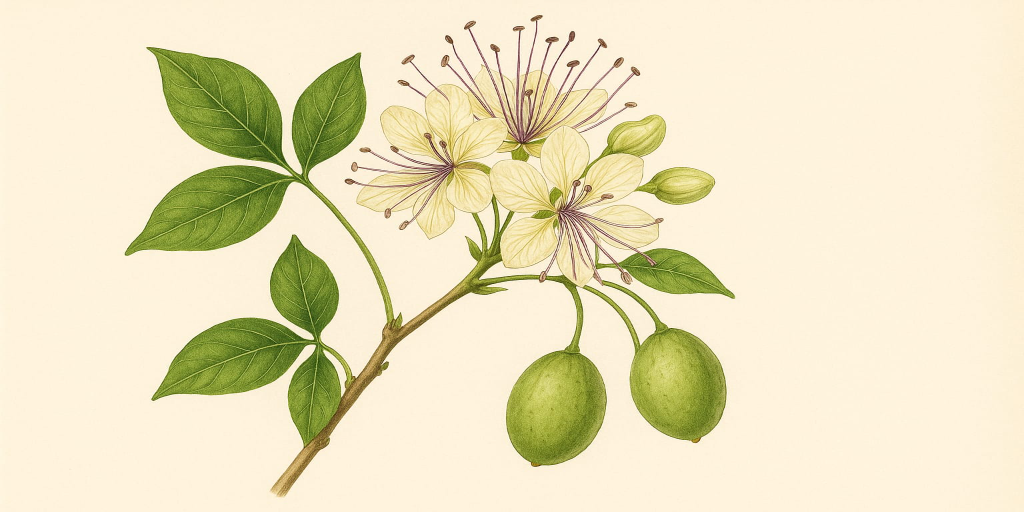
Sanskrit Name:Varuṇa
Devanagari Name:वरुण
English Name: Crateva
Description:
Crataeva nurvala is a deciduous tree that can grow up to 50 feet tall. Its leaves are trifoliate, measuring about 8-12 cm in length, with oval or ovoid leaflets. The tree’s bark is smooth and brown, while its branches display a white hue with purple and yellow patches.
The flowers are fragrant and can be greenish-white, light yellow, or creamy in color. The bark features horizontal wrinkles and is smooth and gray. The fruits are ovoid berries, about 2.5 cm in diameter, resembling lemons, and turn red upon ripening. Each fruit contains multiple seeds surrounded by fresh yellow pulp.
The flowering season occurs in March, with fruits appearing in June. Crataeva nurvala is also known by several synonyms, including three-leaved caper, barun, baruna, borun, holy garlic pear, sacred lingam tree, and triune.
In Ayurveda, this herb has been utilized for over 3000 years, particularly for treating kidney stones, urinary tract infections, prostate disorders, and benign prostatic hypertrophy.
Its bark possesses anti-inflammatory, antiseptic, laxative, and carminative properties. Additionally, it is beneficial for heart health, helping to clear arterial blockages.
Both the bark and leaves are widely used in the preparation of Ayurvedic medicines. The bark is known to yield compounds such as alcohol, lupeol, friedlin, disogenin, and betulinic acid.
Benefits:
- Varuna (Crataeva nurvala) is an important Ayurvedic herb used to support urinary tract health, dissolve kidney stones, and manage prostate disorders.
- It is anti-inflammatory and detoxifying, balancing Kapha and Vata doshas while enhancing renal function.
Medical Conditions(Relief):
- Varuna is beneficial for treating urinary tract infections, kidney stones, and bladder issues.
- It also has anti-inflammatory and detoxifying properties.
Medical Conditions(Avoid):
- Varuna should be avoided by individuals with low blood pressure or those on blood pressure medications.

